



Manufacturing
Top 5 Problems Faced by Small Manufacturers in India and How to Solve Them
Small manufacturers across India face common operational challenges that limit their growth. We break down the top 5 problems and how modern ERP software solves each one.
Introduction
Small and medium manufacturers in India are the backbone of the economy. From machine shops in Chennai to textile units in Surat, these businesses create jobs and serve both domestic and export markets. But they share a common set of operational problems that limit their efficiency and growth.
After working with manufacturers across different sectors, we have identified the five most common problems — and the practical solutions that modern ERP software provides.
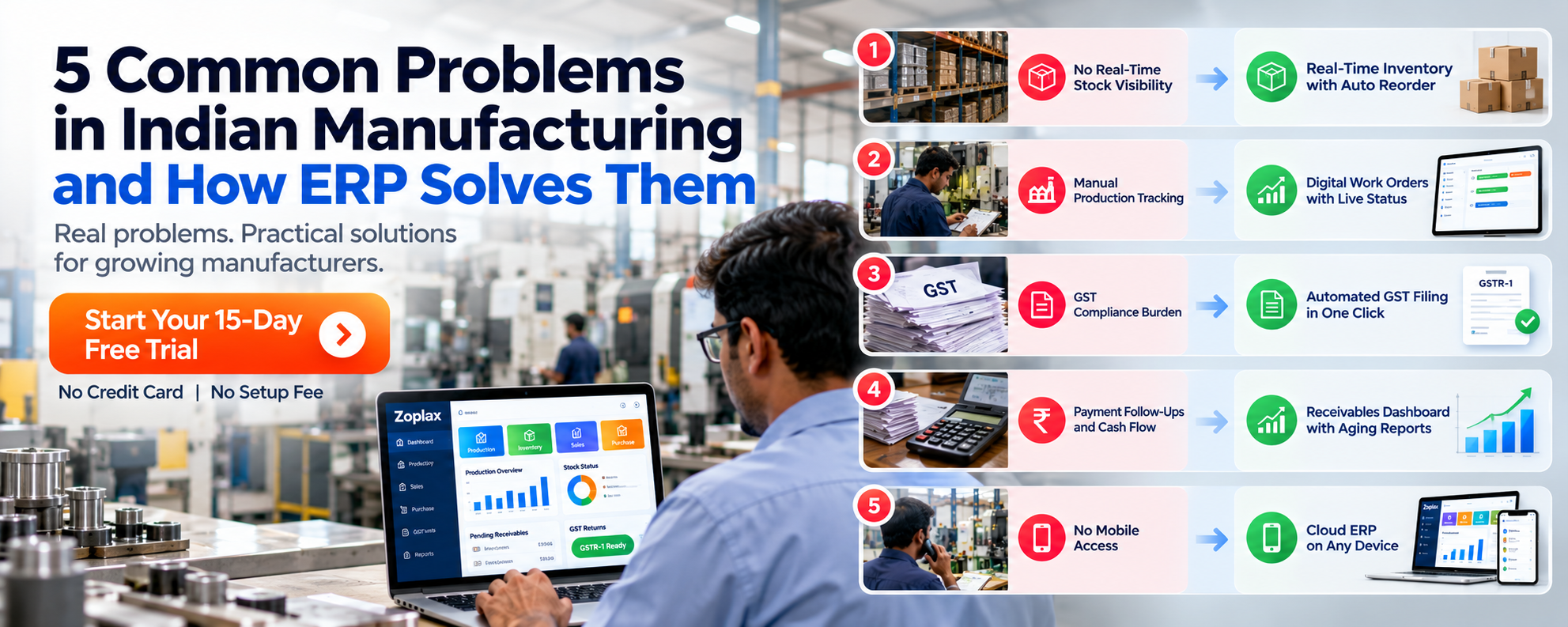
Problem 1: No Real-Time Stock Visibility
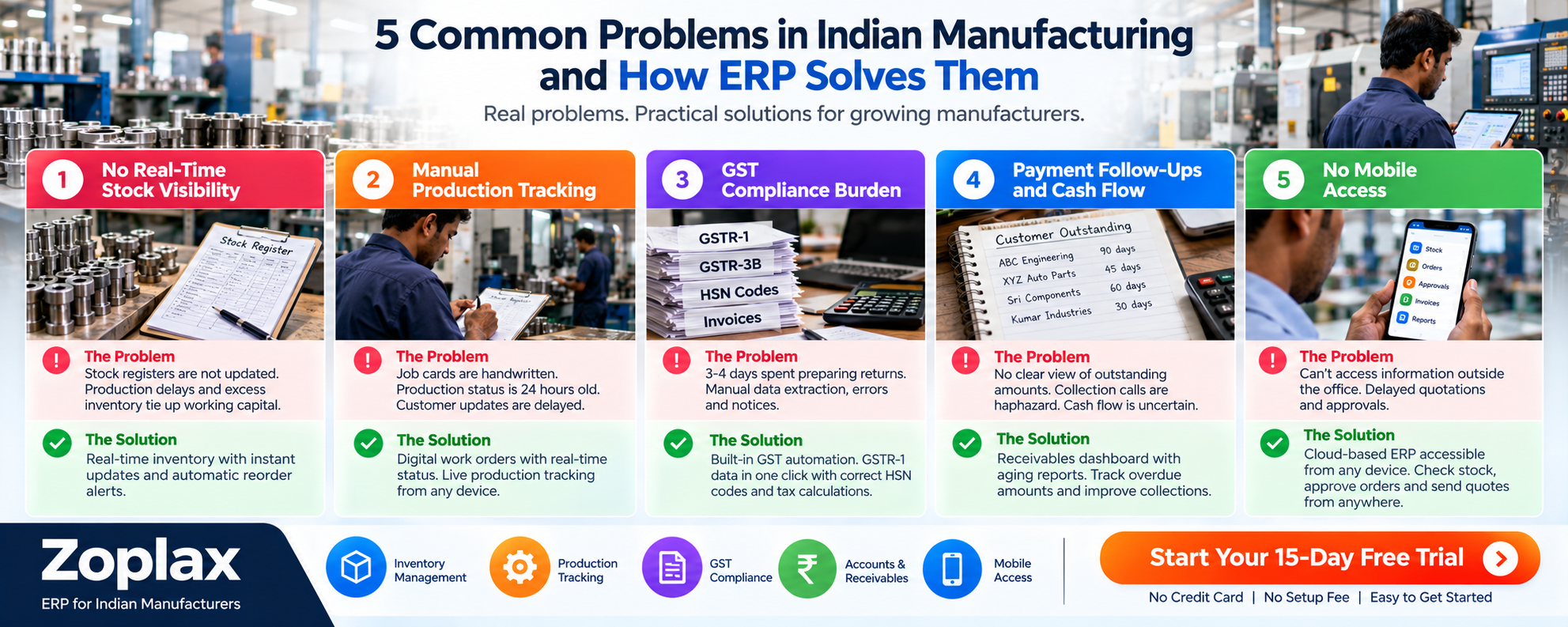
The problem: The store manager keeps a stock register. The production manager asks for a material and discovers it ran out yesterday — but no one updated the register. Meanwhile, the purchase manager ordered excess material last month because they could not tell what was actually in stock.
This leads to production delays, excess inventory tying up working capital, and urgent purchases at premium prices.
The solution: Real-time inventory management with instant updates at every transaction point. When raw material is received, the quantity updates immediately. When it is issued to production, it deducts. When finished goods are packed, they are added to stock. The owner and production manager see the same live data from anywhere.
Automatic reorder alerts notify the purchase team when any item falls below the minimum stock level — before it runs out.
Problem 2: Manual Production Tracking
The problem: Job cards are printed or handwritten. Operators update them manually. At the end of the day, someone collects them and enters them into a spreadsheet. By the time the production manager reviews the data, it is already 24 hours old. Machine breakdowns, operator absences and quality rejects are discovered late.
Customers ask for delivery status updates and the answer is always "let me check and call you back."
The solution: Digital work orders with real-time status updates. Each job has a work order in the system showing which machine it is on, what stage it has reached, and what the estimated completion time is. When a batch is completed or an issue occurs, it is logged immediately.
Production managers get a live view of the shop floor from their phone. Customer enquiries can be answered instantly. Delays are caught early enough to take corrective action.
Problem 3: GST Compliance Burden
The problem: Every month, 3-4 days are lost preparing GST returns. The accountant manually extracts invoice data from Tally or Excel, checks HSN codes, calculates tax, and files returns. Errors and mismatches with supplier filings result in notices and blocked input tax credit.
The solution: ERP with built-in GST automation. Every invoice generated through the system has the correct HSN code, GST rate and tax breakdown already calculated. At month end, GSTR-1 data is available in one click. Input tax credit is tracked automatically against purchase invoices.
The 2-3 days of monthly accountant time reduces to 30 minutes. The risk of errors drops dramatically.
Problem 4: Payment Follow-Ups and Cash Flow
The problem: Customers take 45-60 days to pay. No one knows exactly how much is outstanding from each customer, or which invoices are overdue. The owner is perpetually worried about cash flow but cannot get a clear picture of what is owed.
Collection calls are made haphazardly. Some customers are called twice, others are forgotten. The business is essentially providing interest-free credit to customers without any systematic tracking.
The solution: Outstanding receivables dashboard showing every customer's balance, invoice age, and overdue amounts. Automatic aging reports categorise receivables by 0-30, 31-60, 61-90 days, and 90+ days overdue.
With this visibility, the collections team can prioritise effectively. Some businesses that implement this see a 15-20% improvement in average collection days within the first quarter.
Problem 5: No Mobile Access
The problem: The owner goes to visit a customer. The customer asks for a quote on a new product. The owner has to say "I will call you with the price." They return to the office, look up costs, prepare a quotation, and send it the next day. By then, the customer has already called a competitor.
Or the owner is away from the office and needs to approve a purchase order, but the system is only accessible from the office computer.
The solution: Cloud-based ERP accessible from any device with a browser. The owner can check stock levels, review pending orders, approve purchase requests and send invoices from their phone — from anywhere, at any time.
This is particularly powerful for owners who travel regularly or manage multiple locations.
The Common Thread
All five problems have the same root cause: information is fragmented across different systems, people, and paper records. The solution is a single integrated system where all data flows together automatically.
Zoplax ERP addresses each of these five problems with modules built specifically for the way Indian manufacturers work — with full GST compliance, WhatsApp-friendly mobile access, and pricing designed for MSMEs.
Start your 15-day free trial today. No credit card, no setup fee.
Newsletter
Get practical ERP and GST tips by email.
GST updates, stock and manufacturing tips — practical, not promotional.
No spam. Unsubscribe any time.
Written by the Zoplax team
We build Zoplax, a cloud ERP for Indian businesses, in Chennai — and write about what we learn from manufacturers, transporters, traders and their accountants.
15-day free trial · No card needed
Run your business on one system.
Billing, stock, accounts, GST and payroll in one place — made for traders, manufacturers, transporters, LPG agencies, builders and service labs.